
1. “Lightweight” Metro Trains Are More Energy – Efficient
- Carbon fiber, known as the “King of New Materials,” is an advanced lightweight material with advantages such as low weight, high strength, fatigue resistance, and corrosion resistance. In the field of rail transit technology, lightweight construction is an important way for rail vehicles to achieve green and low – carbon development.
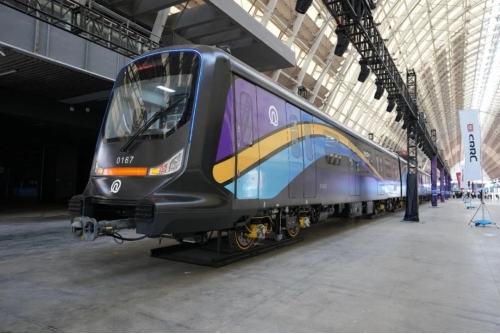
- In recent years, carbon fiber composites have developed rapidly in the rail transit field globally, but their applications have been limited to a few components such as interiors, equipment compartments, car bodies, and bogie frames. CRRC Qingdao Sifang Co., Ltd., in collaboration with Qingdao Metro Group and other organizations, has overcome key technologies such as the integrated design of large and complex main load – bearing structures made of carbon fiber, efficient and low – cost manufacturing, and all – around intelligent inspection and maintenance. In 2024, for the first time in the world, carbon fiber composites were applied to multiple main load – bearing components such as the car body and bogie frame of commercial metro vehicles. According to the operation plan, the “CETROVO 1.0 Carbon Star Rapid Rail” initially went into service on Qingdao Metro Line 1, starting from Shanshan Station and carrying passengers on the Shanshan to Xingguo Road section.
- By using carbon fiber composites, the vehicles achieved significant weight reduction. The “CETROVO 1.0 Carbon Star Rapid Rail” adopted a carbon fiber car body and frame, reducing the weight of the entire vehicle by about 11%. Through the use of carbon fiber composites, the “CETROVO 1.0 Carbon Star Rapid Rail” achieved significant weight reduction.
2.Carbon Fiber Composite System Solutions for the Rail Transit Field
- CETROVO 1.0 is a carbon – fiber – based system solution for the rail transit field. It has two generational features: carbon fiber engineering applications and the deep integration of Smart care with structural health.
- CETROVO 1.0 also established three platforms dedicated to rail transit: a carbon fiber composite design and development platform for rail vehicles, an efficient and low – cost manufacturing platform for carbon fiber composites in rail vehicles, and a full – coverage, modular verification platform for the entire process. This forms a batch engineering application capability for the entire life cycle.
- It is reported that CETROVO 1.0 has broken through core technologies such as integrated design and efficient, low – cost manufacturing, achieving weight reduction, energy consumption reduction, and lower operation and maintenance costs for trains. Focusing on lightweight construction, it deepened the integrated design concept, carried out multi – objective coupling design for load – bearing, installation, sound insulation, heat insulation, and shielding, and developed composite – material – specific structures to reduce the weight of the car body and components. It established a composite – material production line that organically integrates intelligent innovation with efficient production, achieving efficient and low – cost manufacturing. It also set up a five – level modular verification platform, issued six verification regulations for the rail transit field, and shortened the development cycle by 30%.
- Thanks to the application of carbon fiber lightweight materials and new technologies, the wheel – rail wear of carbon fiber metro trains has been significantly reduced, greatly decreasing the maintenance workload of vehicles and tracks and resulting in lower operation and maintenance costs over the entire life cycle. Meanwhile, the “Carbon Star Rapid Rail” applied digital twin technology to build a SmartCare intelligent operation and maintenance platform for carbon fiber trains, achieving intelligent vehicle fault detection, intelligent health assessment, and optimization of repair procedures, reducing maintenance costs. Compared with traditional metal – material metro vehicles, the car body of carbon – fiber metro vehicles is 25% lighter.
3.Full – Scale Domestication from Materials to Technology
- In the urban rail transit field, how to minimize energy consumption, reduce carbon emissions, and create an efficient, low – carbon, and green urban rail system is the top priority of industry development, imposing higher demands on rail vehicle lightweight technologies.
- The main load – bearing structures of the “Carbon Star Rapid Rail,” such as the car body and bogie frame, are all manufactured using carbon fiber composites. For the first time in the world, carbon fiber composites were commercially used in the main load – bearing structures of metro vehicles. Compared with traditional subways, this carbon – fiber metro train has been fully upgraded, making it lighter, more energy – efficient, more comfortable, stronger, with less wheel – rail wear, and lower operation and maintenance costs.
- The “Carbon Star Rapid Rail” is stronger and has a longer structural life. The train uses new high – performance carbon fiber composites to enhance body strength while achieving lightweight construction. Moreover, compared with traditional metal materials, carbon – fiber bogie frame components have stronger impact resistance and superior fatigue performance, extending their service life. It also adopts advanced active radial technology, enabling wheels to navigate bends along the track more flexibly. This significantly reduces wheel – rail wear and noise and enhances environmental adaptability. The use of more wear – resistant and heat – resistant carbon – ceramic brake discs, which are 60% lighter than steel discs and have advantages such as high – temperature resistance, long service life, and adaptability to all weather conditions including sand, snow, and rain, meets the demands for more stringent braking performance.
- It is reported that the “Carbon Star Rapid Rail” has achieved full domestication. The selection of carbon fiber raw materials and process validation have realized 100% domestication of raw materials such as carbon fiber filaments, prepregs, resins, cores, and adhesives, promoting the scaled application of carbon fiber composites in the rail transit field. Over the next three years, carbon – fiber car bodies are expected to be widely applied in inter – city EMUs, high – speed EMUs, and high – speed maglev trains of different speed grades. This will drive the upstream and downstream industries to achieve an annual output value of nearly one billion yuan, providing strong support for China’s green and low – carbon transformation of its rail transit system.


